October 19 | News

What Is Section 1256 and How Does It Benefit Futures Traders?

Section 1256 is the tax rule that gives qualifying futures contracts and certain exchange-traded options their unusual 60/40 treatment.
single-blog-post-featured-image
Section 1256 is the kind of tax rule futures traders wish showed up more often.Make $1 million trading qualifying futures and 60% of that gain gets long-term capital gains treatment, even if you were in and out of the position before lunch. For a fund manager or trading firm, that can move the tax bill by six figures. Suddenly, knowing exactly what qualifies under Section 1256 becomes a lot more interesting than memorizing another piece of the Internal Revenue Code.There’s plenty of room to screw it up too. Open positions get marked to market on December 31. Contracts that look almost identical can land on opposite sides of the rule. Elections made elsewhere on the return can change the outcome before anyone realizes what happened.We deal with those issues every spring for trading firms and commodity pools issuing K-1s to LPs. So let’s put real numbers behind it. We’ll use a $1 million 2026 futures profit to show how Section 1256 works, how much the 60/40 split can save, which contracts qualify, and where traders give the advantage back.

What Is Section 1256?

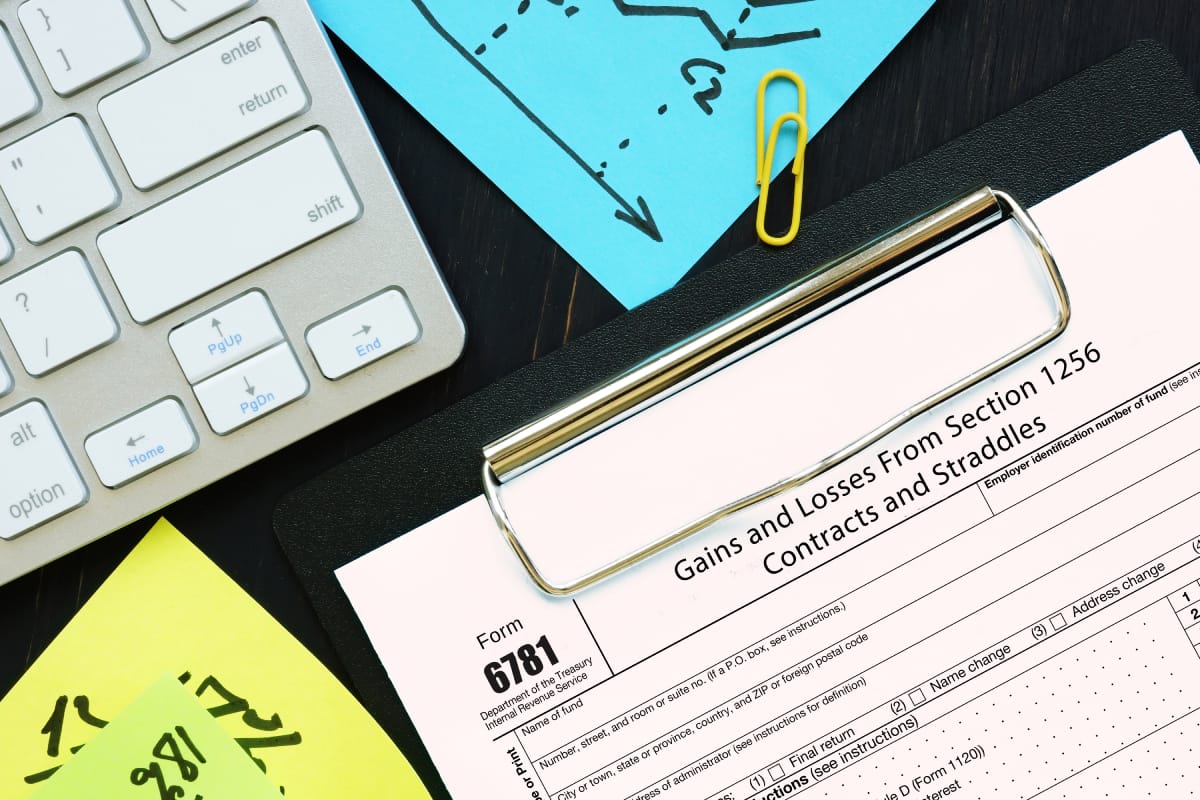
Section 1256 is the tax rule that gives qualifying futures contracts and certain exchange-traded options their unusual 60/40 treatment. Every gain or loss is split 60% long-term and 40% short-term, regardless of whether you held the position for six months, six days, or six minutes.It also changes what happens on December 31. Any qualifying contract still open at year-end is treated as if you sold it at fair market value on the final business day. You recognize the gain or loss then, your basis resets, and when the position eventually closes, you aren’t taxed twice on the same move.The statute technically covers five categories of contracts, but for most traders the important ones are regulated futures, options on futures, and broad-based index options such as SPX. Swaps are excluded, single-stock options generally don’t qualify, and properly identified business hedges receive different treatment.If a contract falls under Section 1256, the tax reporting runs through IRS Form 6781. From there, the real question is what that 60/40 split does to the tax bill.

How Does It Benefit Futures Traders?

The 60/40 split is the headline benefit, but it’s only the start. Section 1256 can lower the effective tax rate on short-term trading profits, cut down the reporting burden, give individual traders a way to claw back tax from earlier profitable years after a loss, and extend favorable treatment into markets well beyond traditional commodities.Go back to the $1 million futures profit from our intro. Here’s what those benefits look like when real money is attached to them.

60% of Your Profit Gets the Lower Long-Term Tax Rate

This is the big one: you don’t have to hold a qualifying futures contract for a year to get long-term capital gains treatment.Section 1256 automatically treats 60% of your gain as long-term and 40% as short-term. For someone in the top tax brackets, that works out to a 26.8% blended federal rate instead of 37% if the entire gain were short-term.On our $1 million 2026 futures profit, that’s roughly $268,000 of federal income tax instead of $370,000. You keep about $102,000 more.The holding period doesn’t change the split either. Close the trade after 10 minutes or 10 months and the same 60/40 treatment applies.For 2026, the 37% bracket starts at $640,600 for single filers and $768,700 for married couples filing jointly. The 3.8% net investment income tax may still apply, but it applies on top of either treatment, so the Section 1256 advantage remains.Run the same book through a commodity pool and the benefit can flow through to the LPs. Their share of the Section 1256 gain is generally reported on Schedule K-1 in Box 11, Code C, with the 60/40 split handled on their own Form 6781.

Your Tax Reporting Gets Much Cleaner

Section 1256 can save active futures traders from having to rebuild an entire year of trading one position at a time.Because qualifying contracts are marked to market at year-end, you don’t have to sort thousands of trades by holding period, match individual tax lots, or spend hours untangling wash sales. The wash sale rule generally doesn’t apply, and your FCM typically reports the year’s Section 1256 result in aggregate on Form 1099-B. That total then feeds into Form 6781.For a fund running a busy futures book, that can turn a disorganized trade-by-trade tax exercise into a much cleaner year-end reconciliation. It can also line up more closely with the fair-value P&L already being used for financial reporting, which helps keep the book-to-tax reconciliation from becoming another project of its own.The trade-off is the same mark-to-market rule that makes the reporting easier. If $400,000 of our $1 million profit is still sitting in an open crude position on December 31, that gain is taxable for 2026 even though the position hasn’t closed yet.Cleaner reporting, in other words, comes with an earlier tax bill. That’s why year-end unrealized gains need to be part of the estimated tax conversation before April.

A Bad Futures Year Can Get You Tax Money Back

This is where Section 1256 gets unusually useful after a losing year.Individuals can carry a net Section 1256 loss back as far as three years and use it against Section 1256 gains they already paid tax on. In plain English, a bad year can reopen a good year and produce a refund.Take our example. The book makes $1 million in 2026, then loses $300,000 in 2027. If there were no Section 1256 gains in 2024 or 2025, Section 1212(c) can let that loss reach back to 2026. At a 26.8% blended rate, the refund could be roughly $80,000.That’s a much better outcome than simply carrying the loss forward and waiting for future gains to use it.You elect the carryback on Form 6781, then claim the refund through the appropriate filing.This benefit also matters when you’re considering a Section 475(f) election. Section 475 can make sense for some traders, but applying it to commodities can mean giving up both 60/40 treatment and this ability to reach back into prior profitable years.A trader can elect Section 475 for securities without necessarily including commodities, so we’d never treat it as an all-or-nothing decision.

Favorable Treatment Across Newer Markets

Section 1256 isn’t limited to old-school futures markets. If the contract qualifies, you can still get the same 60/40 tax treatment while trading newer products such as regulated crypto futures.CME bitcoin, ether, solana, and XRP futures are a good example. They can qualify as regulated futures contracts, which means a crypto fund trading them can get Section 1256 treatment. Trade an offshore perpetual tied to the same coin, and the tax result can be completely different.The same principle applies overseas. A foreign contract doesn’t qualify simply because it looks like a futures contract you’d trade in Chicago. The exchange itself has to meet the rules. In 2026, Rev. Rul. 2026-16 added ICE Endex in the Netherlands for qualifying contracts entered into on or after September 1.For a fund trading across several venues, that gives the choice of market a tax consequence too. You can have nearly identical exposure to the same asset and still end up with different treatment depending on where and how you traded it.The gray areas are where we’d be careful. Prediction markets, for example, don’t fit neatly into the futures rules, and the IRS hasn’t handed traders a blanket Section 1256 answer. Until it does, 60/40 treatment there is something you need to be able to defend, not something we’d assume because the contract happens to trade on a regulated platform.

How Do You Make Sure You Keep the Section 1256 Advantage?

Section 1256 can do a lot for a futures trader on its own. On the $1 million book we’ve followed throughout this article, the 60/40 split can cut the tax bill, the year-end mark simplifies reporting, and a bad 2027 can even reach back into a profitable 2026.Where firms get into trouble is around the edges.A Section 475(f) election can change the treatment you thought you had. The wrong venue can put a contract outside Section 1256. Miss the loss carryback election and a refund stays on the table. Ignore a large December mark and the tax bill can arrive before the cash does.Those are the calls we’ve been helping trading firms and CPOs make for decades. At Michael Coglianese, CPA, P.C., our tax and audit teams work from the same futures book, from year-end marks through partnership returns and K-1s, so Section 1256 gets handled as part of the fund rather than as an April cleanup job.If you’re carrying futures into the year-end, talk to us before December 31 starts making tax decisions for you.

Partner with a team you can count on, year after year.

We’re here to serve you as your partner. To get started, fill out this form, and we’ll be in touch with you soon.

Lincolnshire Office

Michael Coglianese CPA, P.C. ​
300 Tri State International
Suite 180
Lincolnshire, Il. 60069 ​

630.351.4005

info@cogcpa.com